
I foresee great things happening with this website. Yes, I know, I actually have to review books. Here are some of the books that might be reviewed soon:
1. North and South, by Elizabeth Gaskell
2. Emma Brown, by Charlotte Bronte (an unfinished novel).
3. Arrow of God, by Chinua Achebe
4. Illuminations, by Walter Benjamin
5. The Dashwood Sisters' Secrets of Love, Rosie Rushton
6. Persuasion, by Jane Austen
7. The Golden Age, by Tahmima Anam
Yes, I know, it's a huge range, but one of these books should have a review out soon. And I promise to do devote more time.
I also hope to have a twitter account of short running book reviews.
Sunday, May 31, 2009

Thursday, March 26, 2009
Eat Pray Love: the monstrous review.
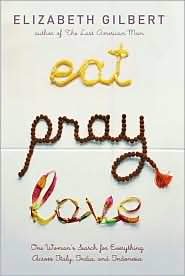
I just couldn't do justice to the book in my earlier review attempts (and perhaps even in this one), though the fact that I keep trying should signify that it's profoundly affected me in some way. Sure, maybe not the way that the author intended to make an impression -- because if she wrote with a little more sensitivity and on a completely different subject she might've been likable. But being that it was this book and that Elizabeth Gilbert wrote it, I had to make of it what I could. And at first it didn't seem like anyone in the universe agreed with me. Then I came to the realization that a supermajority of readers found this book a manifestation of a deep personal desire -- or at least, a fantastic amalgam of many such desires.
It's not merely about entertainment anymore. If you believe most reviews, this book will show us our best way forward. If you believe most book clubs, women on the subway, train or waiting around in line, millions have had their lives "changed" by this book.
This is what makes Eat, Pray, Love so dangerous.
(This, by the way, isn't Gilbert's fault. She just wrote the book.)
Let me put a few things in context here.
A good friend of mine from high school invited me along with some mutual friends over to her house. As we were all waiting for rides home, Sue (the friend) sat with us in the library so we could observe the driveway. Her bookshelves were very full, so it was only a matter of time before I had to thumb through the many spines. I came across Eat Pray Love. Just before I was about to put the book back into the shelf, I could hear Sue's voice -- soft and earnest -- say the following:
This Book Changed My Life.
So [obviously] I had to read it.
I brought it along with me whenever I went into the city because I thought that it was going to be a heavy game-changing book. Of course, the cover made EPL look like a beach-read, but look at how they managed to dumb down most of the 70s classic pulp-fiction paperbacks! (for example, consider everything Hunter Thompson ever wrote and Zen and the Art of Motorcycle Maintenance.)
Now that I've read it twice, thrice, four times over, I can say that it might have changed my life. Again, not the way that Gilbert intended.
So the premise goes like this: the author, a woman named Elizabeth Gilbert, wakes up to find that one fine day she doesn't want to have children, and that she needs to leave her husband because this is not working out. Whatever this is. Her old life -- and the crushing weight of expectation -- became frighteningly repulsive to her. When I read the beginning I wondered what she must've left out. In the book, she shrugs it off as uninteresting, but I just can't take her word for it.
(In the NYTimes review for this book, the writer Jennifer Egan agrees with me on this, in her mostly positive response. She says, "... I found myself more interested, finally, in the awkward, unresolved stuff she must have chosen to leave out." So was I.)
She receives word from this Balinese holy man named Ketut Liyer -- while she's in Indonesia for something totally unrelated to self-discovery -- that she'll end up making a humongous trip across the world to, erm, find herself. Sure. At first I took it as an interesting literary/plot device. Point taken: this trip has been pre-ordained.
After my initial irritation at being shut out from the root of her problems, I continue reading her Italian adventures. Italy comes out of her fascination with the beautiful Italian language -- and she does give us a very thorough explanation of the origins of modern Italian. After she's learned enough Italian she decides to participate in an exchange program that will allow her total immersion in the strange and wonderful country that is Italy. She fantasizes about sleeping with a whole bunch of guys and eats her heart out -- a part which I appreciated, nobody ever talks about the beneficial aspects of eating your guts outs in brilliant out-of-the-way trattorias. Even here she managed to be irritating. She came off as too cute -- too glib -- too needy. She needs to convince us that having a good time is against her moral grain because ordinarily she's such a hard worker, descended from a line of hard workers ... so in Italy she wants to let go of her over-thinking. This is where she fails. Miserably.
Though I have to say this: I give her points for this part because it's easily the least annoying section of this book. This is because I have a perverse fascination for anything food-related, and she certainly describes all of her good eats and the people she knows very well. (Tomatoes with Mozzarella! Asparagus and parmesan and prosciutto! Bolognese sauce!) I liked her Luca Spaghetti, the crazy soccer games -- what's not to love about a good old fashioned Vafancculo! in the middle of a book?
An irrational voice in the back of my head wonders how she lives with the fact that she's having a dandy time while the poor fellow she left behind is probably stuck with a house that he doesn't want with her memory plastered all over the place.
Though no hard feelings, Elizabeth: I want the names of all those restaurants you visited.
Anyway, we move on to India. It's the pray part of the trip. She's introduced to a guru -- "Amma" -- by her boyfriend David (remember, he's the man she shacked up with after she separated from her husband). Amma's this beautiful Indian woman who has an ashram somewhere outside Bombay. So our heroine Elizbaeth wants to go to India, thinking that somehow immersion in herself will allow herself to function properly. And this is where it starts to get positively infuriating. There's little in the way of action in this chapter, and there's a self-centeredness that's pretty appalling on paper. As a reader I don't like reading about people's spiritual discoveries. I couldn't see the difference between her sudden discovery of religion and every other annoying white-Californian hippie yoga fantasy constructed around sitting in an ashram ad infinitum.
Okay, so I'm an impatient person. I like to see action. I found myself skipping through most of this chapter, while reflecting on how insensitive she was in parts and how little she learned about her actual surroundings. Again: I guess this was the point, but it doesn't make me sympathetic to her. We hear her whine about how she doesn't like chanting, the Indian heat, the dirtiness, and the poverty. She doesn't really go out to see much in the way of poverty. In the Ashram's walls she's well insulated from the screaming, claustrophobic world around her. There's a Richard from Texas who tries to slam some sense into her, but it doesn't seem to work even though she thinks it does. I believe the point of all this was that she managed to let her previous relationships go or something, except it was such a long, drawn out process that was ultimately personally insignificant.
I wondered whether I was a defective person after this: I kept wondering whether I was supposed to care. Or how it was possible for me to care. And I just couldn't.
So now we follow this woman to Indonesia, where she meets the man who told her to come there in the beginning. Ketut Liyer, the ancient medicine doctor.
Aside from visiting with him, though, she doesn't seem to have much else to do with her life. So instead she teaches the old medicine man English. Through him, as well as a local library, she realizes her total misconception of her idea of Bali as a utopia, though the place seems to be working pretty well for her. A banged up knee allows Ketut Liyer to pawn her off on some other healer, a woman named Wayan -- who at first seems to be totally beautiful, wonderful and charming. She's divorced from an abusive husband and is eking out a name for herself as a very competant healer. Through the customers who show up there, Elizabeth meets a whole cadre of Brazilians. One of them, named Filipe, is the man she later shacks up with. Through him she indulges in a lot of self praise -- "through him I realized that I was blah blah blah ..." was what she said a million and three times.
Wayan, for whom Ms. Glibert raised $18,000 via a rigorous e-mail campaign to her New York friends so that she could buy a house for herself and her daughter -- was overcome with the shock of having so much money. Through help from her boyfriend Felipe she bullied Wayan into either spending the money on a new house or giving it back. Lesson given, house bought, Elizabeth then goes on to have great fun with her new boyfriend and now the year has come full circle in gorgeous Bali. All is right with the world.
And this -- this -- is the recipe for happiness. How's that for alarming?
First, here is the disturbing trend. We're at Aesop's point: what's the moral of this story? I feel that it's this: We're told that it is perfectly all right to break as many hearts and to trample as many people as we want in order to get something approximating peace. We are told that somehow self-fulfillment can come after an extraordinary physical journey that tears away at the fabric of a preexisting life, and this this very selfish desire is being repackaged as a brutal and necessary sacrifice. As a reader I can't help but pass judgment and wonder what exactly is so magical about taking a huge advance, traveling in luxury, and finding "true happiness" on the carcass of someone else's distress.
Maybe through her spiritual journey she didn't understand the true idea of Karma. One's misdeeds are supposed to come back with a vengeance. Hers certainly hadn't.
Then there is a matter of perspective: in my pursuit of (admittedly) negative reviews of this book I found the following -- a review by Rolf Potts.
Potts says this:
"Let’s pretend, for purely rhetorical purposes, that I—an American male journalist—wrote a travel book about a quest for sensuality and spiritual growth. Let’s say that the plot of my book could be briefly summarized as follows:
As I enter my 30s, I find myself emotionally unsatisfied. I have achieved professional success as a writer, I own a new house, and my wife is ready to have kids, but somehow it all just feels wrong in a way I can’t quite identify ... I elect to assuage my unhappiness by shacking up with a cuter, younger writer-actress woman from New York.
Soon, I come to love the cute, young writer-actress in a way I could never love my wife. But then, due to social and personal uncertainty, I start picking fights with the writer-actress, who isn’t reciprocating my emotional intensity or sexual appetite ... I decide—amid further jags of weeping and self-pity—to settle my divorce, quit my job, take a year off and wander the world in search of sensual pleasure and spiritual epiphany.
I start by going to Italy, where I eat a lot of pasta, drive around and take some naps. I also study the language with a cute, younger Italian woman ... at the end of my Italian sojourn, I shell out for a new wardrobe and go to India to explore spirituality ... neglecting to experience the cultural context of my spiritual discipline does not keep me from having many fabulous spiritual epiphanies. ... I am learning tons about how to better live through a life that has been lacerated with the painful emotional legacy of success ...
I end my journey by looking for “balance” in Bali, where I make many charming friends who constantly assure me how handsome and wonderful I am ... I have a wise old Guru in Bali, too, but I eventually stop seeing this Guru because I meet a lovely Brazilian divorcee businesswoman who wants nothing more than to have sex all day, drone on about how handsome I am and make declarations of unconditional love.
Finally happy, I congratulate myself for having the inner fortitude to travel into the world and solve my problems.
Do you think American women would embrace this book and turn it into a bestseller? Or do you think American women would react with hostility at such a self-absorbed, culturally oblivious and vaguely sexist narrative? No doubt it would be the latter reaction—and I would be reduced to dodging rotten fruit at book readings."
(Rolf Potts, c. 2008)
I think that this perspective is spot-on. He goes on to mention that once upon a time men who were stuck in their respective jobs read adventure porn the same way that women read this book: to escape from their hole-in-the-wall lives the same way that men from the fifties escaped theirs to "civilize the natives" and seduce a few of the white women caught on the wrong side of the cultural divide.
As an American woman it is a shame if this stereotype was allowed to exist -- though by the looks of a frustrated community of men on the internet called Men Who Go Their Own Way, it already does. Mr. Potts concedes that women don't believe that this is a practical perspective on how to live life, though I have to say that I disagree with him. I personally knew women who took life decisions to sever their connections to their "old" lives, go abroad, in indulge in ultimately self-destructive fantasies. I'm not saying Gilbert's fantasies were self-destructive, but her copycats don't seem to be able to tell the difference.
Instead, what we should be telling ourselves is that we should try to be happy and find self-fulfillment in what we already have. That it might not be a courageous decision to take piles of cash and strategically blow them in different beautiful locales around the globe.
If we equate happiness in our present situations as settling, then we've failed to understand what Ms. Gilbert's journey was all about. To her credit, I really don't think she thought that this was the best way for everyone to achieve personal salvation, but every other woman desperate for a solution that doesn't involve taking care of their busy households or holding down that boring job might not think that sinking into debt to finance a worldwide trip is a bad idea. I would say that that's a ridiculous extrapolation to make, except that I do know people who've done this and have come back even more heartbroken and dissatisfied.
This book is going to be made into a movie and more people are going to be tempted by this unattainable fantasy. Not that it shouldn't be made -- part of what makes this country great is its dream-fulfillment -- but I fear for others who think that this is a "life-changing" book. It's certainly life-changing; it encourages us all as women to take the easy way out. We are in no way entitled to anything we want: love, affection, material wealth. We have to earn it. This is another endearing American quality -- to know that if you work hard enough for something you will get it.
While I wish Ms. Gilbert the best, I hope her female readers see this book for what is: a year in the life of a bright but deeply-flawed woman. It is not "life-changing" and it shouldn't change anyone's plans. Find your own quest for self-fulfillment. And please do this reader a favor; don't make me read it.
Tuesday, March 17, 2009
blahdy blah excuses.
Yes, I'm awful. So. What can I say?
These days I'm working at the library and it's getting difficult to update regularly. Imagine, giving these excuses when I'm surrounded by books? Lately I've been indulging in books I'd never review on here, books by authors like Sharon Shinn, that Opal book by Kaavya Vishwanathan and a few books by my old professors from college which are interesting to read, if only in retrospect. There are some interesting and worthwhile books I've pursued.
Just recently I read How I Live Now for the three-thousandth time. I know I'm not supposed to mention these books so far in advance, but I can't help it. I love it.
So that's what I've been doing. EPL on its way soon. I promise. Even if I have to write it -- BY HAND -- on the train up to NY on Friday. I think perhaps I will. Definitely a worthy exercise.
Look also for me to dissect the Guardian top 100 into mini review slices. I actually planned on doing that as well tonight but life got in the way -- as it always does.
That's all for now.
These days I'm working at the library and it's getting difficult to update regularly. Imagine, giving these excuses when I'm surrounded by books? Lately I've been indulging in books I'd never review on here, books by authors like Sharon Shinn, that Opal book by Kaavya Vishwanathan and a few books by my old professors from college which are interesting to read, if only in retrospect. There are some interesting and worthwhile books I've pursued.
Just recently I read How I Live Now for the three-thousandth time. I know I'm not supposed to mention these books so far in advance, but I can't help it. I love it.
So that's what I've been doing. EPL on its way soon. I promise. Even if I have to write it -- BY HAND -- on the train up to NY on Friday. I think perhaps I will. Definitely a worthy exercise.
Look also for me to dissect the Guardian top 100 into mini review slices. I actually planned on doing that as well tonight but life got in the way -- as it always does.
That's all for now.
Sunday, March 15, 2009
Yet another useless update message

I know -- when I said tomorrow, I lied.
This seems to be a blog composed solely of my excuses, so I have to apologize profusely. More will come up. However, an interesting update: I've been considering buying Bolano's 2666. I believe anything he writes is absolutely brilliant. I'm considering whether or not it's worth keeping because the book (or the copy with the three mini-books) is $30, which is a little much for me.
I've just gotten through the Alexandria Quartet again. I'm going to save a post or few about those books later on. There is much that is wonderful about them and there is a lot left to be desired. Durrell is a fantastic writer whose conception of reality has come under fire a lot, especially during discussions of postcolonial theory.
Eat Pray Love is that mythical review: each time I swear I'll write it, I never do. It's like the jinx that kills the project. I won't let it kill this one! I swear -- I just won't!
Wednesday, March 11, 2009
Notice
Coming up tomorrow:
A review of Eat, Pray, Love!
Also, a further discussion of the negative review.
(Yes, these two are related!)
I apologize for not updating today. I wasn't feeling well.
I promise you'll see something tomorrow. It's definitely my most passionate project to date. It's a shame that it'll be in the direction that it is, but there are other books that inspire me in different ways. The tone of the next piece will in no way represent the way I handle future book reviews.
Enough disclaimers. Good night!
A review of Eat, Pray, Love!
Also, a further discussion of the negative review.
(Yes, these two are related!)
I apologize for not updating today. I wasn't feeling well.
I promise you'll see something tomorrow. It's definitely my most passionate project to date. It's a shame that it'll be in the direction that it is, but there are other books that inspire me in different ways. The tone of the next piece will in no way represent the way I handle future book reviews.
Enough disclaimers. Good night!
Tuesday, March 10, 2009
The Black Veil: a mini-review, or a review of a review.

This is possibly the funniest book review I've read in a long time.
I happen to agree with the reviewer too, though I wouldn't have used such strong language. I've definitely read worse than Rick Moody, but he's one of the least self-aware writers on my bookshelf. This reviewer discussed the Black Veil, Moody's memoir. He said it much better than I could. I'm not sure I'll be great at giving caustic reviews -- because I love to love books, and I don't like disliking them. But I did dislike this one and I'm so happy I found someone who articulated my opinion. I fell off my chair reading this one!
The Black Veil suffers from "too many words" the way that Mozart's music didn't suffer from "too many notes". While Mozart's contemporaries did not understand the complexities of his music they've withstood centuries of study. I'm not sure I can say the same for this memoir. It's one of the few books I just could not get through.
(I can't say how rare that is. I always finish books.)
I read the first few paragraphs and I felt that perhaps Mr. Moody had an idea as to how he'd like others to perceive his life. Far from being succinct, he editorializes to the point where his experiences -- and the experiences of those family members he writes about -- become inauthentic. He can rhapsodize about going to the bathroom. Each aspect of his life is suffused with a degree of importance that just isn't there.
Maybe I have unreasonable expectations of my memoirs, and I demand that my authors have interesting lives. But I have a feeling that this memoir might have been interesting if he'd concentrated on different aspects of his setting, if he'd stopped using million dollar words and instead focused on the simplicity of honest, straightforward storytelling. I was under the impression that this book might've been much, much shorter and a heck of a lot easier to read if he'd written it that way.
I'm not too bitter. I spent a dollar on this book at the Princeton library, where I go every week with my friend. We're good study partners, and annoy each other only as much as is absolutely necessary. This book will serve as a marker of the time we spent together. The cover I have is very, very pretty. Though it does have that horrific and misleading quote from the Washington Post: "Compulsively readable ... A profound meditation on madness, shame and history ... one of the finest memoirs in recent years." I beg to disagree.
I swear this isn't my review of the day, but I couldn't let this opportunity go. That review was too good.
Monday, March 9, 2009
Drown

I think I'll tackle Drown first.
Always good to inaugurate on a high note, right?
I saw this book for the first time at the Strand, three years ago. (Winter of 2006, if I remember correctly, which I can't say for sure because I wasn't keeping records then.) It was selling for seven dollars, which was three more dollars than I had at the time, but that didn't stop me from smashing my knees up against the stacks trying to finish it while my friends pursued the science fiction section. I hate borrowing money from people, but I thought about it; truly, I did. I'm happy I didn't in the end, because I bought it for full price two months ago. Diaz deserves every penny of the ridiculous trade paperback price. (It came to $29 for both books.)
Diaz won the Pulitzer for his (incredible) virtuosic novel: The Brief Adventures of Oscar Wao. Between these two works I don't think there are enough positive superlatives to hurl at him. Drown, his 1996 short-story collection, is much more compact. I don't want to say that it's more or less intense than his novel, but short stories are, as a rule. As a collection they're linked by palpable restlessness and a desire to understand themselves: to these narrators, I have to say good luck because understanding diaspora politics is impossible. Understanding New Jersey is another thing altogether.
So this is why I feel that I found the Holy Grail within these short stories. I don't mean to refer to the flawlessness of the writing -- which has everything to do with it -- but the characterization and strength of his voice. I can't say how many times in that Strand where I was thinking, "shit, I know that place," or that I've a good friend of mine give yet another friend almost exactly the same advice on women -- see the story How to date a Browngirl, Blackgirl, Whitegirl or Halfie.
I hate the word hooked but this thing had me from word go.
To explain: The first story Ysrael's about these two kids who unmask a boy whose face's been permanently scarred by a hog attack. We're in the DR now -- and we go from the DR to Jersey and back every now and then; this is Diaz's MO. Other writers are famous for that -- ie, Jhumpa Lahiri, and trust me, a comparison is warranted and it will be given. We get the sense of exactly what is going to happen from the beginning: Young Yunior and his brother Rafa are going to see Ysrael. Diaz doesn't have to give us a lot but we know what's going on. We know from Yunior what his relationship with Rafa is: they hate each other in the company of others but get along fine on their own. Rafa loves his ladies and some of them are stupid creatures -- one of them thinks she can't get pregnant if she has a Coke first. Yunior is either too young or too inept, but it's probably his youth. But they both have a fascination with Ysrael, which is something that draws them together. The long and the short of it -- they corner Ysrael, unmask him after a long, friendly three way conversation about getting his face fixed in the States. It's a violent move that finally unmasks Ysrael. It shocked me as I was reading it.
With this story we get essence of the DR without our heads being slammed into adjectives. This I appreciated. I also loved his leaving out the quotations. Yunior is an unreliable narrator, and somehow leaving out the punctuation allowed an effective synthesis of action and narrative. (Also, stylistically: he uses Spanish and leaves the burden of understanding to context clues. I prefer this. Not just because I understood what he was saying without his having to translate but because I prefer this in general. I find that a glossary is a sign of insecurity when it comes to writing about the unknown. There are other ways that writers try to insert the meaning of non-English words; these devices just don't work. Stop. Some of these tricks include prose outside the quotation marks. Some of time the characters give dissertations about words or concepts. None of that was ever a problem but this was just for the record.)
Fiesta, 1980 was one of my true favorites in this collection. I loved this Yunior. Throughout the story, and this party, Yunior's inability to keep his food while the car is moving is -- I hazard -- sort of symbolic as to how he can't keep it in about his father's affair with some Puerto Rican woman. They're visiting his mother's younger sister in her new Bronx apartment. We have his parents set up nicely. His father is, for the want of a better word, a real dick. He's got a bad temper, takes it out on his children, and sleeps around. Because Yunior has motion-sickness he's not allowed to eat at these parties. His mother is in the know about her husband's relationship, and there are some very evocative moments where her sister snubs Yunior's father at the party. (She knows, too.) It's a subject that nobody will talk about: my favorite quote comes from the one time Yunior brings up the subject, and Rafa says: "Hey, Yunior, guess what happened yesterday? I met Papa's sucia!"
I have to say this: I loved how they went on the Turnpike. Of course they have to go on the Turnpike! I know. No significance whatsoever. But. Exit 11! Oftentimes I find that writers write through New Jersey: as in, the state is en route to somewhere more important. Those who write about New Jersey make it sound like an unrecognizable wasteland. So for making it a place that I understood I have to give him credit. I know those New Brunswick clubs with the college chicks. I know the filthiness of the Raritan. I know his Edison! I know his Quisqueyas in Washington Heights!
I'm not going to talk about any of the other stories specifically, because I urge you to read them: all of them are exemplary, though I will recommend Drown and Negocios as standouts.
What make these stories different from others that I've read -- is their purity. Often, there are terrifying climax points, where something violent and consequential happens. Sometimes the subtle and the understated aren't enough. Movies shouldn't be the only place to go experience sheer, beautiful chaos.
His prose is relatively spare and I know that there are those that prefer lushness. But there's lots of room for the imagination here. Though it might be difficult to understand as someone from New Jersey knows the Northeast corridor intimately none of this rang false. He speaks with a real sensitivity about the places that they're in. Edison -- the GWB -- The Bronx all take on the roles of characters, silent witnesses to the narrators' internal -- and external explosions.
There's lots of exploration of sexual repression in these short stories. The pursuit of pussy is constantly brought up, but Diaz always has an appreciation for the pre and post-coital intimacies of sex that's tender and disarming. Sure, if I had a dime for every instance of the words "culo" and "tetas" and "chinga" I'd probably be able to buy myself lunch which, in Princeton, is no mean feat. Still, love with these narrators is a way to address problems within themselves -- they admit that their view is flawed but it defines them nevertheless. In love, sex, mask-smashing and isolation they tell us to take them as they are.
With such fine writing it's impossible not to do just that.
Always good to inaugurate on a high note, right?
I saw this book for the first time at the Strand, three years ago. (Winter of 2006, if I remember correctly, which I can't say for sure because I wasn't keeping records then.) It was selling for seven dollars, which was three more dollars than I had at the time, but that didn't stop me from smashing my knees up against the stacks trying to finish it while my friends pursued the science fiction section. I hate borrowing money from people, but I thought about it; truly, I did. I'm happy I didn't in the end, because I bought it for full price two months ago. Diaz deserves every penny of the ridiculous trade paperback price. (It came to $29 for both books.)
Diaz won the Pulitzer for his (incredible) virtuosic novel: The Brief Adventures of Oscar Wao. Between these two works I don't think there are enough positive superlatives to hurl at him. Drown, his 1996 short-story collection, is much more compact. I don't want to say that it's more or less intense than his novel, but short stories are, as a rule. As a collection they're linked by palpable restlessness and a desire to understand themselves: to these narrators, I have to say good luck because understanding diaspora politics is impossible. Understanding New Jersey is another thing altogether.
So this is why I feel that I found the Holy Grail within these short stories. I don't mean to refer to the flawlessness of the writing -- which has everything to do with it -- but the characterization and strength of his voice. I can't say how many times in that Strand where I was thinking, "shit, I know that place," or that I've a good friend of mine give yet another friend almost exactly the same advice on women -- see the story How to date a Browngirl, Blackgirl, Whitegirl or Halfie.
I hate the word hooked but this thing had me from word go.
To explain: The first story Ysrael's about these two kids who unmask a boy whose face's been permanently scarred by a hog attack. We're in the DR now -- and we go from the DR to Jersey and back every now and then; this is Diaz's MO. Other writers are famous for that -- ie, Jhumpa Lahiri, and trust me, a comparison is warranted and it will be given. We get the sense of exactly what is going to happen from the beginning: Young Yunior and his brother Rafa are going to see Ysrael. Diaz doesn't have to give us a lot but we know what's going on. We know from Yunior what his relationship with Rafa is: they hate each other in the company of others but get along fine on their own. Rafa loves his ladies and some of them are stupid creatures -- one of them thinks she can't get pregnant if she has a Coke first. Yunior is either too young or too inept, but it's probably his youth. But they both have a fascination with Ysrael, which is something that draws them together. The long and the short of it -- they corner Ysrael, unmask him after a long, friendly three way conversation about getting his face fixed in the States. It's a violent move that finally unmasks Ysrael. It shocked me as I was reading it.
With this story we get essence of the DR without our heads being slammed into adjectives. This I appreciated. I also loved his leaving out the quotations. Yunior is an unreliable narrator, and somehow leaving out the punctuation allowed an effective synthesis of action and narrative. (Also, stylistically: he uses Spanish and leaves the burden of understanding to context clues. I prefer this. Not just because I understood what he was saying without his having to translate but because I prefer this in general. I find that a glossary is a sign of insecurity when it comes to writing about the unknown. There are other ways that writers try to insert the meaning of non-English words; these devices just don't work. Stop. Some of these tricks include prose outside the quotation marks. Some of time the characters give dissertations about words or concepts. None of that was ever a problem but this was just for the record.)
Fiesta, 1980 was one of my true favorites in this collection. I loved this Yunior. Throughout the story, and this party, Yunior's inability to keep his food while the car is moving is -- I hazard -- sort of symbolic as to how he can't keep it in about his father's affair with some Puerto Rican woman. They're visiting his mother's younger sister in her new Bronx apartment. We have his parents set up nicely. His father is, for the want of a better word, a real dick. He's got a bad temper, takes it out on his children, and sleeps around. Because Yunior has motion-sickness he's not allowed to eat at these parties. His mother is in the know about her husband's relationship, and there are some very evocative moments where her sister snubs Yunior's father at the party. (She knows, too.) It's a subject that nobody will talk about: my favorite quote comes from the one time Yunior brings up the subject, and Rafa says: "Hey, Yunior, guess what happened yesterday? I met Papa's sucia!"
I have to say this: I loved how they went on the Turnpike. Of course they have to go on the Turnpike! I know. No significance whatsoever. But. Exit 11! Oftentimes I find that writers write through New Jersey: as in, the state is en route to somewhere more important. Those who write about New Jersey make it sound like an unrecognizable wasteland. So for making it a place that I understood I have to give him credit. I know those New Brunswick clubs with the college chicks. I know the filthiness of the Raritan. I know his Edison! I know his Quisqueyas in Washington Heights!
I'm not going to talk about any of the other stories specifically, because I urge you to read them: all of them are exemplary, though I will recommend Drown and Negocios as standouts.
What make these stories different from others that I've read -- is their purity. Often, there are terrifying climax points, where something violent and consequential happens. Sometimes the subtle and the understated aren't enough. Movies shouldn't be the only place to go experience sheer, beautiful chaos.
His prose is relatively spare and I know that there are those that prefer lushness. But there's lots of room for the imagination here. Though it might be difficult to understand as someone from New Jersey knows the Northeast corridor intimately none of this rang false. He speaks with a real sensitivity about the places that they're in. Edison -- the GWB -- The Bronx all take on the roles of characters, silent witnesses to the narrators' internal -- and external explosions.
There's lots of exploration of sexual repression in these short stories. The pursuit of pussy is constantly brought up, but Diaz always has an appreciation for the pre and post-coital intimacies of sex that's tender and disarming. Sure, if I had a dime for every instance of the words "culo" and "tetas" and "chinga" I'd probably be able to buy myself lunch which, in Princeton, is no mean feat. Still, love with these narrators is a way to address problems within themselves -- they admit that their view is flawed but it defines them nevertheless. In love, sex, mask-smashing and isolation they tell us to take them as they are.
With such fine writing it's impossible not to do just that.
Subscribe to:
Posts (Atom)
