
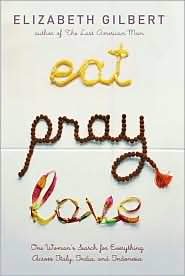
I just couldn't do justice to the book in my earlier review attempts (and perhaps even in this one), though the fact that I keep trying should signify that it's profoundly affected me in some way. Sure, maybe not the way that the author intended to make an impression -- because if she wrote with a little more sensitivity and on a completely different subject she might've been likable. But being that it was this book and that Elizabeth Gilbert wrote it, I had to make of it what I could. And at first it didn't seem like anyone in the universe agreed with me. Then I came to the realization that a supermajority of readers found this book a manifestation of a deep personal desire -- or at least, a fantastic amalgam of many such desires.
It's not merely about entertainment anymore. If you believe most reviews, this book will show us our best way forward. If you believe most book clubs, women on the subway, train or waiting around in line, millions have had their lives "changed" by this book.
This is what makes Eat, Pray, Love so dangerous.
(This, by the way, isn't Gilbert's fault. She just wrote the book.)
Let me put a few things in context here.
A good friend of mine from high school invited me along with some mutual friends over to her house. As we were all waiting for rides home, Sue (the friend) sat with us in the library so we could observe the driveway. Her bookshelves were very full, so it was only a matter of time before I had to thumb through the many spines. I came across Eat Pray Love. Just before I was about to put the book back into the shelf, I could hear Sue's voice -- soft and earnest -- say the following:
This Book Changed My Life.
So [obviously] I had to read it.
I brought it along with me whenever I went into the city because I thought that it was going to be a heavy game-changing book. Of course, the cover made EPL look like a beach-read, but look at how they managed to dumb down most of the 70s classic pulp-fiction paperbacks! (for example, consider everything Hunter Thompson ever wrote and Zen and the Art of Motorcycle Maintenance.)
Now that I've read it twice, thrice, four times over, I can say that it might have changed my life. Again, not the way that Gilbert intended.
So the premise goes like this: the author, a woman named Elizabeth Gilbert, wakes up to find that one fine day she doesn't want to have children, and that she needs to leave her husband because this is not working out. Whatever this is. Her old life -- and the crushing weight of expectation -- became frighteningly repulsive to her. When I read the beginning I wondered what she must've left out. In the book, she shrugs it off as uninteresting, but I just can't take her word for it.
(In the NYTimes review for this book, the writer Jennifer Egan agrees with me on this, in her mostly positive response. She says, "... I found myself more interested, finally, in the awkward, unresolved stuff she must have chosen to leave out." So was I.)
She receives word from this Balinese holy man named Ketut Liyer -- while she's in Indonesia for something totally unrelated to self-discovery -- that she'll end up making a humongous trip across the world to, erm, find herself. Sure. At first I took it as an interesting literary/plot device. Point taken: this trip has been pre-ordained.
After my initial irritation at being shut out from the root of her problems, I continue reading her Italian adventures. Italy comes out of her fascination with the beautiful Italian language -- and she does give us a very thorough explanation of the origins of modern Italian. After she's learned enough Italian she decides to participate in an exchange program that will allow her total immersion in the strange and wonderful country that is Italy. She fantasizes about sleeping with a whole bunch of guys and eats her heart out -- a part which I appreciated, nobody ever talks about the beneficial aspects of eating your guts outs in brilliant out-of-the-way trattorias. Even here she managed to be irritating. She came off as too cute -- too glib -- too needy. She needs to convince us that having a good time is against her moral grain because ordinarily she's such a hard worker, descended from a line of hard workers ... so in Italy she wants to let go of her over-thinking. This is where she fails. Miserably.
Though I have to say this: I give her points for this part because it's easily the least annoying section of this book. This is because I have a perverse fascination for anything food-related, and she certainly describes all of her good eats and the people she knows very well. (Tomatoes with Mozzarella! Asparagus and parmesan and prosciutto! Bolognese sauce!) I liked her Luca Spaghetti, the crazy soccer games -- what's not to love about a good old fashioned Vafancculo! in the middle of a book?
An irrational voice in the back of my head wonders how she lives with the fact that she's having a dandy time while the poor fellow she left behind is probably stuck with a house that he doesn't want with her memory plastered all over the place.
Though no hard feelings, Elizabeth: I want the names of all those restaurants you visited.
Anyway, we move on to India. It's the pray part of the trip. She's introduced to a guru -- "Amma" -- by her boyfriend David (remember, he's the man she shacked up with after she separated from her husband). Amma's this beautiful Indian woman who has an ashram somewhere outside Bombay. So our heroine Elizbaeth wants to go to India, thinking that somehow immersion in herself will allow herself to function properly. And this is where it starts to get positively infuriating. There's little in the way of action in this chapter, and there's a self-centeredness that's pretty appalling on paper. As a reader I don't like reading about people's spiritual discoveries. I couldn't see the difference between her sudden discovery of religion and every other annoying white-Californian hippie yoga fantasy constructed around sitting in an ashram ad infinitum.
Okay, so I'm an impatient person. I like to see action. I found myself skipping through most of this chapter, while reflecting on how insensitive she was in parts and how little she learned about her actual surroundings. Again: I guess this was the point, but it doesn't make me sympathetic to her. We hear her whine about how she doesn't like chanting, the Indian heat, the dirtiness, and the poverty. She doesn't really go out to see much in the way of poverty. In the Ashram's walls she's well insulated from the screaming, claustrophobic world around her. There's a Richard from Texas who tries to slam some sense into her, but it doesn't seem to work even though she thinks it does. I believe the point of all this was that she managed to let her previous relationships go or something, except it was such a long, drawn out process that was ultimately personally insignificant.
I wondered whether I was a defective person after this: I kept wondering whether I was supposed to care. Or how it was possible for me to care. And I just couldn't.
So now we follow this woman to Indonesia, where she meets the man who told her to come there in the beginning. Ketut Liyer, the ancient medicine doctor.
Aside from visiting with him, though, she doesn't seem to have much else to do with her life. So instead she teaches the old medicine man English. Through him, as well as a local library, she realizes her total misconception of her idea of Bali as a utopia, though the place seems to be working pretty well for her. A banged up knee allows Ketut Liyer to pawn her off on some other healer, a woman named Wayan -- who at first seems to be totally beautiful, wonderful and charming. She's divorced from an abusive husband and is eking out a name for herself as a very competant healer. Through the customers who show up there, Elizabeth meets a whole cadre of Brazilians. One of them, named Filipe, is the man she later shacks up with. Through him she indulges in a lot of self praise -- "through him I realized that I was blah blah blah ..." was what she said a million and three times.
Wayan, for whom Ms. Glibert raised $18,000 via a rigorous e-mail campaign to her New York friends so that she could buy a house for herself and her daughter -- was overcome with the shock of having so much money. Through help from her boyfriend Felipe she bullied Wayan into either spending the money on a new house or giving it back. Lesson given, house bought, Elizabeth then goes on to have great fun with her new boyfriend and now the year has come full circle in gorgeous Bali. All is right with the world.
And this -- this -- is the recipe for happiness. How's that for alarming?
First, here is the disturbing trend. We're at Aesop's point: what's the moral of this story? I feel that it's this: We're told that it is perfectly all right to break as many hearts and to trample as many people as we want in order to get something approximating peace. We are told that somehow self-fulfillment can come after an extraordinary physical journey that tears away at the fabric of a preexisting life, and this this very selfish desire is being repackaged as a brutal and necessary sacrifice. As a reader I can't help but pass judgment and wonder what exactly is so magical about taking a huge advance, traveling in luxury, and finding "true happiness" on the carcass of someone else's distress.
Maybe through her spiritual journey she didn't understand the true idea of Karma. One's misdeeds are supposed to come back with a vengeance. Hers certainly hadn't.
Then there is a matter of perspective: in my pursuit of (admittedly) negative reviews of this book I found the following -- a review by Rolf Potts.
Potts says this:
"Let’s pretend, for purely rhetorical purposes, that I—an American male journalist—wrote a travel book about a quest for sensuality and spiritual growth. Let’s say that the plot of my book could be briefly summarized as follows:
As I enter my 30s, I find myself emotionally unsatisfied. I have achieved professional success as a writer, I own a new house, and my wife is ready to have kids, but somehow it all just feels wrong in a way I can’t quite identify ... I elect to assuage my unhappiness by shacking up with a cuter, younger writer-actress woman from New York.
Soon, I come to love the cute, young writer-actress in a way I could never love my wife. But then, due to social and personal uncertainty, I start picking fights with the writer-actress, who isn’t reciprocating my emotional intensity or sexual appetite ... I decide—amid further jags of weeping and self-pity—to settle my divorce, quit my job, take a year off and wander the world in search of sensual pleasure and spiritual epiphany.
I start by going to Italy, where I eat a lot of pasta, drive around and take some naps. I also study the language with a cute, younger Italian woman ... at the end of my Italian sojourn, I shell out for a new wardrobe and go to India to explore spirituality ... neglecting to experience the cultural context of my spiritual discipline does not keep me from having many fabulous spiritual epiphanies. ... I am learning tons about how to better live through a life that has been lacerated with the painful emotional legacy of success ...
I end my journey by looking for “balance” in Bali, where I make many charming friends who constantly assure me how handsome and wonderful I am ... I have a wise old Guru in Bali, too, but I eventually stop seeing this Guru because I meet a lovely Brazilian divorcee businesswoman who wants nothing more than to have sex all day, drone on about how handsome I am and make declarations of unconditional love.
Finally happy, I congratulate myself for having the inner fortitude to travel into the world and solve my problems.
Do you think American women would embrace this book and turn it into a bestseller? Or do you think American women would react with hostility at such a self-absorbed, culturally oblivious and vaguely sexist narrative? No doubt it would be the latter reaction—and I would be reduced to dodging rotten fruit at book readings."
(Rolf Potts, c. 2008)
I think that this perspective is spot-on. He goes on to mention that once upon a time men who were stuck in their respective jobs read adventure porn the same way that women read this book: to escape from their hole-in-the-wall lives the same way that men from the fifties escaped theirs to "civilize the natives" and seduce a few of the white women caught on the wrong side of the cultural divide.
As an American woman it is a shame if this stereotype was allowed to exist -- though by the looks of a frustrated community of men on the internet called Men Who Go Their Own Way, it already does. Mr. Potts concedes that women don't believe that this is a practical perspective on how to live life, though I have to say that I disagree with him. I personally knew women who took life decisions to sever their connections to their "old" lives, go abroad, in indulge in ultimately self-destructive fantasies. I'm not saying Gilbert's fantasies were self-destructive, but her copycats don't seem to be able to tell the difference.
Instead, what we should be telling ourselves is that we should try to be happy and find self-fulfillment in what we already have. That it might not be a courageous decision to take piles of cash and strategically blow them in different beautiful locales around the globe.
If we equate happiness in our present situations as settling, then we've failed to understand what Ms. Gilbert's journey was all about. To her credit, I really don't think she thought that this was the best way for everyone to achieve personal salvation, but every other woman desperate for a solution that doesn't involve taking care of their busy households or holding down that boring job might not think that sinking into debt to finance a worldwide trip is a bad idea. I would say that that's a ridiculous extrapolation to make, except that I do know people who've done this and have come back even more heartbroken and dissatisfied.
This book is going to be made into a movie and more people are going to be tempted by this unattainable fantasy. Not that it shouldn't be made -- part of what makes this country great is its dream-fulfillment -- but I fear for others who think that this is a "life-changing" book. It's certainly life-changing; it encourages us all as women to take the easy way out. We are in no way entitled to anything we want: love, affection, material wealth. We have to earn it. This is another endearing American quality -- to know that if you work hard enough for something you will get it.
While I wish Ms. Gilbert the best, I hope her female readers see this book for what is: a year in the life of a bright but deeply-flawed woman. It is not "life-changing" and it shouldn't change anyone's plans. Find your own quest for self-fulfillment. And please do this reader a favor; don't make me read it.


No comments:
Post a Comment